Learning Outcomes
i. Comprehend the diverse applications of satellites, recognizing their transformative impact on communication, navigation, and scientific research.
ii. Explore the role of satellites in enabling real-time worldwide communication, including voice calls, internet access, and television broadcasting.
iii. Understand the utilization of satellites in navigation systems, such as Global Positioning Systems (GPS), facilitating precise location tracking and navigation.
iv. Appreciate the importance of satellites in monitoring Earth's conditions, including weather patterns, environmental changes, and natural disasters.
v. Gain insights into the role of satellites in astronomical observations, providing a clear view of the universe beyond the interference of Earth's atmosphere.
Introduction
As we navigate our modern world, the invisible presence of satellites permeates almost every aspect of our lives. From the voice calls we make to the weather updates we receive, these artificial moons orbiting Earth have revolutionized communication, navigation, and our understanding of the universe. In this lesson, we embark on a journey to explore the diverse applications of satellites, unveiling their transformative impact on our daily lives and scientific endeavors.
i. Communication Satellites: Bridging the Distance
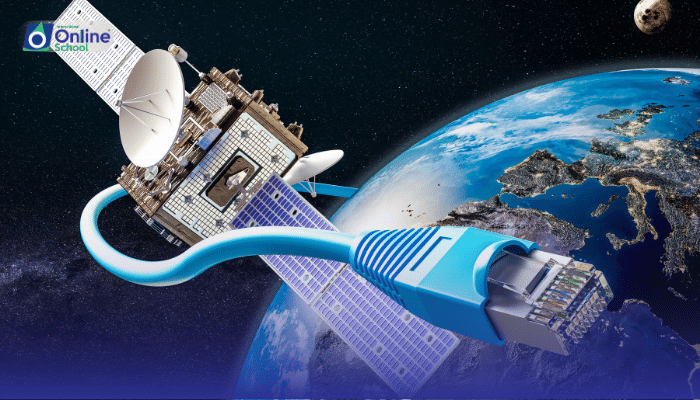
Satellites have become the backbone of global communication, enabling seamless connectivity across vast distances. Communication satellites relay signals between different points on Earth, facilitating voice calls, internet access, and television broadcasting. These satellites are strategically positioned in geostationary orbits, maintaining a fixed position relative to Earth, ensuring uninterrupted signal transmission.
ii. Navigation Satellites: Guiding Our Way
Satellites have revolutionized navigation, providing precise location tracking and guidance. The Global Positioning System (GPS), a network of navigation satellites, utilizes signals from multiple satellites to determine the exact position of a GPS receiver. This technology has become indispensable for transportation, mapping, and various outdoor activities.
iii. Earth Observation Satellites: Monitoring Our Planet
Satellites play a crucial role in monitoring Earth's conditions, providing invaluable data for weather forecasting, environmental monitoring, and disaster response. Earth observation satellites collect data on various parameters, including temperature, vegetation cover, and ocean conditions, enabling scientists and policymakers to track changes in the environment and respond effectively to natural disasters.
iv. Astronomical Satellites: Unveiling the Cosmos
Satellites have opened up a new window to the universe, allowing us to observe celestial objects without the interference of Earth's atmosphere. Astronomical satellites, equipped with powerful telescopes and sensors, have made groundbreaking discoveries, from the composition of distant stars to the existence of exoplanets.
v. The Ripple Effect of Satellites: A Transformative Force
The applications of satellites extend far beyond communication, navigation, and scientific research. They have revolutionized agriculture, enabling precision farming and crop monitoring; they have enhanced resource exploration, identifying potential mineral deposits; and they have facilitated disaster relief efforts, providing real-time communication and imagery in the aftermath of natural disasters.
Satellites have become an indispensable part of our modern world, silently shaping our daily lives and expanding our understanding of the universe. Their diverse applications, from enabling seamless communication to unlocking the secrets of the cosmos, underscore their transformative impact on society and scientific progress. As we continue to explore the potential of satellites, we can envision a future where these artificial moons play an even greater role in shaping a more connected, sustainable, and knowledge-driven world.
